


Catllaràs Forest Hike | Medium-Hard Trail to Gaudí’s Cabin & Ruins
Scenic medium-hard winter hike through Catllaràs Forest. Explore Gaudí’s Xalet, panoramic viewpoints, and snowshoe-friendly trails near La Pobla de Lillet
Views:
1k
About La Pobla de Lillet and the Catllaràs Forest
La Pobla de Lillet is a quaint medieval town in the Berguedà region of the Catalan Pyrenees. The Llobregat River flows through its centre, crossing under several stone footbridges such as the Pont Vell and Ponte de la Petita. The town retains its old-world charm with historic buildings like the 18th-century baroque temple Església de Santa Maria, and has a legacy of textile mills once powered by the river. Other notable attractions include the 16th-century Monestir de Santa Maria de Lillet and the Parc d'Aventures del Catllaràs.
Today, the town’s principal industries are tourism, agriculture, and the Agustí Barral paper mill. It’s a popular destination for both winter getaways and summer retreats. In winter, the surrounding forest glows with colour and offers excellent snowshoe hiking and mushroom foraging. In summer, the sweet fragrance of pine forests in the protected Serra del Catllaràs and the flowing waters of the Llobregat create an idyllic setting. Deer, wild horses, and grouse roam freely beneath pine and beech trees.
Antoni Gaudí, though most associated with Barcelona, contributed two lesser-known works to La Pobla de Lillet thanks to his patron and friend Eusebi Güell. Güell built the Asland Cement Factory in 1901 on the mountains above the town — the first manufacturing complex in Catalonia designed to produce cement from local limestone and coal sourced from the Minas del Catllaràs, powered by hydraulic energy from the Llobregat River.
- 1905 – Xalet del Catllaràs: A large, three-storey wooden cabin in the Bosc del Catllaràs forest, originally built to house coal miners. The structure features Gaudí’s signature catenary arches and organic design. It was abandoned for decades but has recently been restored to its original form.
- 1905–1906 – Jardins Artigas: A walking garden with a marked route and several architectural highlights. These include the Glorieta viewpoint, the Cave — original site of the Fuente de la Magnesia — where Gaudí used catenary arches, and the Cascada fountain built with trencadís mosaic and vegetal ironwork coated in cement. Other features include a snack bar next to the Puente de los Arcos (with symbolic male and female forms), and coiled snake sculptures lining the path to the Glorieta.
The cement factory closed in 1975 and was partially dismantled to sell its machinery for scrap. What remains is now the Museu del Ciment de Castellar de n'Hug. Connecting the museum to the town is an 11 km narrow-gauge tourist railway, the Tren del Ciment, which was originally used to transport cement and now stops at Jardins Artigas en route to the museum.

Jardins Artigas
Author: turismelillet.cat

Xalet del Catllaràs
Author: turismelillet.cat

Museu del Ciment de Castellar de n'Hug
Author: museuciment.cat

Tren del Ciment
Author: turistren.cat
This blog is primarily about the Bosc del Catllaràs hiking route via Xalet del Catllaràs — a trail that blends natural beauty, cultural heritage, and architectural intrigue.
Image Gallery For Catllaràs Forest Winter Hiking
Click on any of the 52 images to open full screen gallery player. Note that viewing images is subject to our Fair Use Policy.
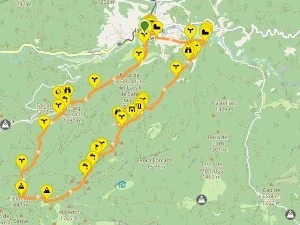
Bosc de Catllaràs Hiking Route
Start from the Casa de la Vila de la Pobla de Lillet and follow Camí de l'Escorxador until you see a telephone pole on the left marked with a red and white stripe. Take the ascending footpath here, turning left and then right, skirting a field with a helicopter pad.
At the top of the field, turn left and continue straight onto the Camí Ral de la Pobla de Lillet a Falgars. This path ascends through forest past Roca de la Ferradura del Cavall de Sant Marc (1080 m), along the Serra de Falgars, and up to the Mirador Joan Casanova, a viewpoint overlooking the valley of La Pobla de Lillet.
Continue a little further to reach the Santuari de Santa Maria de Falgars (1288 m), a chapel and hostel with architectural elements from the 9th, 10th, and 15th centuries. From the sanctuary, backtrack slightly and follow the road to a T-junction. Look for steps leading onto a forest path toward Pla de Sant Cristòfol and Camp de l’Ermita. Pay close attention to your GPS here — the forest has many intersecting trails.
After Collet del Llobató (1628 m), the path curves left and passes several rocky outcrops: Roca del Catllaràs (1689 m), Roca del Cortel (1642 m), and Font Assedegosa, a natural spring with a wooden log channel. The ground may be marshy near Font del Prat Gespedor. This area often has free-roaming mountain horses drawn by the natural water sources.
Continue past Roc del Joc de Pilota (1615 m) and Roc de la Devessa Juvana. At Collet Fred, look for a short signed detour to the Mirador del Roc de la Lluna. It’s worth the climb — this is the best viewpoint on the route. Once back on the main trail, continue to the recently restored Xalet del Catllaràs, Gaudí’s mountain cabin.
From the Xalet, follow the path to the rocky summit crowned by the ruins of Castell de Lillet. The next waypoints are Rotonda Sant Miquel de Lillet and Santa Maria de la Pobla de Lillet. From here, the trail descends back into the town.
Bosc de Catllaràs Hiking with a Dog
This route passes through mixed forest — oak, beech, and pine — with occasional open plains where free-roaming horses and cattle may be encountered. In spring and summer, be cautious of Pine Processionary Caterpillars, which are toxic to dogs. However, in autumn and winter (the recommended seasons), they are unlikely to be present. The trail is suitable for dogs, and the main viewpoint has steps and railings for safe access.
Where to Eat in La Pobla de Lillet
Between the main road bridge and the stone footbridge Ponte de la Petita, you’ll find several bars and restaurants:
- La Borda de Lillet: Restaurant
- La Rosalía: Bar
- Cal Pericas Restaurant: Located across the river, just beyond Ponte de la Petita
The Museu del Ciment de Castellar de n'Hug also has a bar, La Cantina del Clot del Moro, which serves burgers and chips — a good option if you’re visiting the museum after your hike.
La Pobla de Lillet Seasonal Opening Times
- Xalet del Catllaràs: Can be admired from the outside. The interior is still under refurbishment and not currently open to visitors.
- Museu del Ciment de Castellar de n'Hug: Open March to November. Tickets: 6 € (adults), 4 € (children, seniors, disabled).
- Tren del Ciment: Operates on the same schedule as the museum. Return tickets cost between 4 € and 9 €. Check the official website for exact times.
- Jardins Artigas: Open year-round with seasonal hours. Tickets: 5 € (adults), 4.50 € (children and seniors).
- Monestir de Santa Maria de Lillet: Opening hours are not published — inquire at the town’s tourist information office.
- Parc d’Aventures del Catllaràs: Open from late March through the end of September.
What to take for Catllaràs Forest Winter Hiking
Pack a standard mountain hiking rucksack with essentials suited for mixed forest terrain and variable weather. Although there are natural springs along the route, they may be frozen in winter — so bring at least 3 litres of water.
Recommended gear:
- Layered clothing — breathable base layer, insulating mid-layer, and waterproof outer shell
- Sturdy hiking boots — suitable for rocky paths, marshy ground, and occasional snow
- GPS device or smartphone with offline maps — forest trails can be confusing
- Snacks and energy food — especially if you plan to detour to viewpoints or springs
- Gloves and hat — essential in colder months
- Headlamp or torch — useful if visibility drops or you’re hiking near dusk
- Camera or binoculars — for wildlife spotting and panoramic views
- Dog gear (if applicable) — water bowl, lead, and paw protection for rough terrain
Catllaràs Forest Winter Hiking Summary of Prices
Train/Bus Fare
Entry Ticket
Additional Information
Train/Bus Fare
Entry Ticket
Additional Information
Adult
€ 25.00
€ 0.00
Child
€ 25.00
€ 0.00
Getting to La Pobla de Lillet
Address: Caratera Santuari de Falgar s/n, La Pobla de Lillet, 08696
To reach La Pobla de Lillet by car, take the C-16 motorwayGuardiola de Berguedà, exit onto the B-402 and follow it for 8 km until you arrive in La Pobla de Lillet. At the edge of town, you’ll find public parking near the trailhead.
For a scenic and tasty stop en route, consider pulling into the Circs petrol station on the C-16. It’s home to a well-known roadside café called Els Portals de Cercs, which features a rear terrace overlooking the Pantà de la Baells reservoir. The café is known for its generous counter of homemade sweet and savoury pastries — arguably the best in this part of Catalonia.
Wikiloc Trail for Catllaràs Forest Winter Hiking
Please sign in with Google to view the Wikiloc Route map.
Sign in with Google