


Please sign in with Google to view the map.
Sign in with GoogleCau Ferrat & Maricel Museum Sitges – Modernist Art Guide
Explore Cau Ferrat and the Maricel Museum in Sitges. Discover Santiago Rusiñol’s modernist home, Catalan art collections, and visiting information for both museums
Views:
2.6k
About Sitges Cau Ferrat house and Maricel Art Museum
Cau Ferrat Museum and the Maricel Museum form the cultural heart of Sitges and are part of the Museus de Sitges network. Together, they showcase one of the most important collections of Catalan Modernism and early 20th‑century art on the Costa Dorada. Sitges became a key artistic hub at the end of the 19th century, attracting painters, writers, and musicians who helped shape the Modernist movement.
About Cau Ferrat Museum
The Cau Ferrat Museum was founded in 1893 as the home and studio of Santiago Rusiñol Prats (1861–1931), one of the leading figures of Catalan Modernisme. After his death, the house was converted into a public museum in 1933, preserving his artistic legacy and personal collections.
The building contains Rusiñol’s original living quarters on the ground floor, including his kitchen, study, bedroom, and reception rooms. A staircase leads to the spectacular first‑floor Great Hall, a vaulted space filled with ironwork, paintings, ceramics, glass, furniture, and Modernist art. Between 2010 and 2014, the entire museum underwent a major restoration to preserve its architectural and artistic heritage.
The Cau Ferrat collection includes works by:
- Santiago Rusiñol
- Ramon Casas i Carbó (1866–1932), Modernist painter
- Pablo Ruiz Picasso — see also the Picasso Museum Barcelona
- Ramon Pichot Gironès (1871–1925), Impressionist painter and early mentor of Salvador Dalí
- Ignacio Zuloaga (1870–1945), Basque painter
- Darío de Regoyos (1857–1913), Impressionist painter
- William Degouve de Nuncques (1867–1935), Belgian Symbolist painter
- Manuel Martínez Hugué (1872–1945), Noucentista sculptor
- Enric Clarasó i Daudí (1857–1941), Modernist sculptor
- Pablo Gargallo (1881–1934), Modernist sculptor
About Maricel Museum
The Maricel Museum houses a wide‑ranging art collection from the 10th century to the early 20th century, covering Romanesque, Gothic, Renaissance, Baroque, Modernisme, and Noucentisme. It is one of the most important art museums in Sitges and a key part of the town’s cultural heritage.
Dr. Jesús Pérez‑Rosales, a prominent doctor and collector, donated a significant portion of the museum’s artworks.
Since 2012, the Sitges Heritage Association has expanded the collection with works by:
- Miquel Utrillo i Morlius — painter, engineer, and architect of the Maricel Palace
- Arcadi Mas i Fondevila (1852–1931), founder of the Sitges Luminist School
- Artur Carbonell i Carbonell (1906–1973), Surrealist painter and theatre director
- Agustí Ferrer i Pino (1884–1960), painter
The museum also includes works on loan from the Government of Catalonia, the Provincial Government of Barcelona, and the Montserrat Museum, featuring artists associated with Modernisme and Noucentisme such as:
- Joaquim Sunyer (1874–1956), Noucentista painter
- Lola Anglada i Sarriera, writer, illustrator, and painter
- Alfred Sisquella i Oriol, painter of still lifes and interior scenes
- Furniture from Can Falç, the historic Sitges family home now being transformed into a cultural centre
Image Gallery For Sitges Cau Ferrat house and Maricel Art Museum
Click on any of the 63 images to open full screen gallery player. Note that viewing images is subject to our Fair Use Policy.
Visiting Sitges Cau Ferrat house and Maricel Art Museum
The Cau Ferrat Museum and the Maricel Museum can be visited with a single combined ticket, and both museums are connected by an internal circular route. The visit begins on the ground floor of Cau Ferrat.
From here, the route crosses into Casa Rocamora, where you’ll find the tiled fireplace room, and then leads directly into the second floor of the Maricel Museum. The final part of the visit includes the first‑floor galleries of Maricel, featuring Noucentista sculpture and sea‑view rooms overlooking the Sitges coastline.
Museus de Sitges also offers guided tours, cultural walks, and themed visits focused on Modernisme, Noucentisme, and the artistic heritage of Sitges. For group bookings or special tours, contact the museum using the details provided on their official website.
I visited using the individual combined ticket for both museums, which cost 10 euros for adults. Tickets are usually available on arrival, although booking ahead is recommended during summer weekends and holidays.
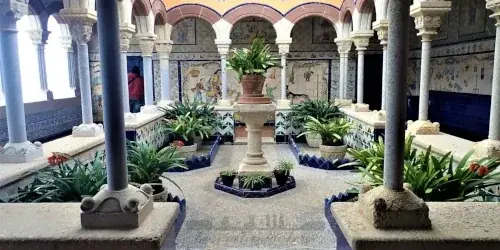
On my visit, the highlight of the Cau Ferrat Museum was the striking blue room on the ground floor. The vivid tiles, ironwork, and the small indoor fountain create an atmosphere that feels both intimate and theatrical. Pay close attention to the tiles surrounding the fountain and you will see cartoon like figurines picturing rural Catalan life. It’s one of the most distinctive spaces in any Sitges museum.
Upstairs, the attic hall is extraordinary — an enormous timber‑vaulted ceiling that rises like the nave of a church. The scale of the room, combined with the collection of Modernist paintings and forged iron pieces, makes it one of the most memorable interiors in the entire Museus de Sitges network. The oak‑panelled room adjoining it is equally exquisite, with warm tones and craftsmanship that reflect the artistic spirit of the house.
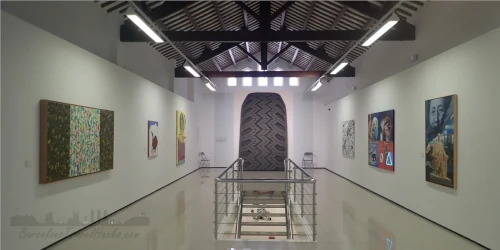
The Maricel Museum, by contrast, has a more modernist architectural feel, with clean lines and exposed structural elements. One of the most impressive spaces is the former indoor patio, now enclosed with floor‑to‑ceiling glass. The windows frame uninterrupted views of the Mediterranean, creating a gallery space that feels open, bright, and directly connected to the sea. It’s a beautiful example of how Sitges blends art, architecture, and coastal landscape.
Top tip: Download the official Museus de Sitges app (Android and iOS) to use as an audio guide during your visit. The app provides detailed explanations of the artworks and museum spaces. Bring headphones and connect to the museum’s free Wi‑Fi to access the guide.
Cau Ferrat Museum & Maricel Museum Opening Hours
- November, December January & February - Tuesday to Sunday: 10:00am to 5:00pm
- March, April, May, June & October - Tuesday to Sunday: 10:00am to 7:00pm
- July, August & September - Tuesday to Sunday: 10:00am to 8:00pm
- Closed: Monday's
Note: Maricel Museum should not be confused with the Maricel Palace. This is the white building on the other side of Calle de Fonollar and has limited visiting hours on a Sunday.
Accessibility of Sitges Cau Ferrat house and Maricel Art Museum
Access to the Cau Ferrat Museum and Maricel Museum begins from a cobbled street, and the entrance involves a short flight of steps. Inside the museums, several areas are connected by narrow staircases, particularly when moving between floors in Cau Ferrat. However, there is an internal lift that provides step‑free access to the main exhibition levels of both museums.
If you need to confirm accessibility details—such as lift availability, mobility support, or adapted routes—contact the museum directly on 93 894 03 64 or email museusdesitges@diba.cat. Staff are generally helpful and can advise on the best way to visit if you have reduced mobility.
There are no bicycle anchorage points near the museum entrance, so cyclists should plan to lock bikes elsewhere in the historic centre.
Large rucksacks and bulky bags are not permitted inside the museums, and space at reception is limited. I was allowed to enter with my small 10L daypack, but anything larger may need to be left at your accommodation.
Sitges Cau Ferrat house and Maricel Art Museum Summary of Prices
Train/Bus Fare
Entry Ticket
Additional Information
Train/Bus Fare
Entry Ticket
Additional Information
Adult
€ 9.20
€ 10.00
Student uder 25 and Seniors, 5 Euros
Child
€ 9.20
FREE
Under 13 years free
Group/Family Ticket?
Contact museum for group discounts
Free Entry?
Consult Website for free days
Getting to Sitges Cau Ferrat house and Maricel Art Museum
Address: Carrer de Fonollar, Sitges, 08870
The Cau Ferrat Museum and Maricel Museum are located in the historic centre of Sitges, directly behind the iconic seaside church on the small headland. From Sitges train station, it’s an easy 10‑minute walk through the old town, following the pedestrian streets down towards the seafront.
If you’re arriving from Barcelona, the museums are included in most Sitges day trip walking routes. The path from the station takes you past shops, cafés, and the waterfront promenade before reaching Carrer de Fonollar, one of the most picturesque streets in Sitges.
For detailed transport information—including trains, buses, and parking—see the Sitges Day Trip page, which covers how to get to Sitges from Barcelona and the best ways to reach the museums on foot.
Documents for Sitges Cau Ferrat house and Maricel Art Museum
Map for Sitges Cau Ferrat house and Maricel Art Museum
Weather for Sitges
Where to stay near Sitges Cau Ferrat house and Maricel Art Museum
Nearby Attractions to Sitges Cau Ferrat house and Maricel Art Museum
 TRAIN
TRAIN
7.1k views
GR‑92 Garraf to Sitges Hike – Coastal Trail & Trinitat Viewpoint
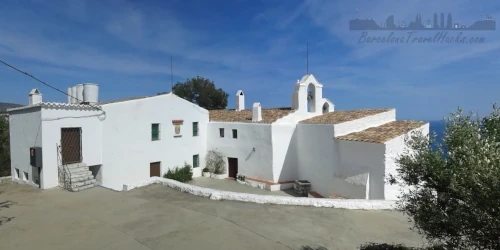
Hike the 15 km GR‑92 trail from Garraf to Sitges via mines, farmsteads, coastal viewpoints and the Trinitat Hermitage, featured in The Night Manager Season 2
Read more >
 TRAIN
TRAIN
3.5k views
Sitges Beaches & Shopping Guide
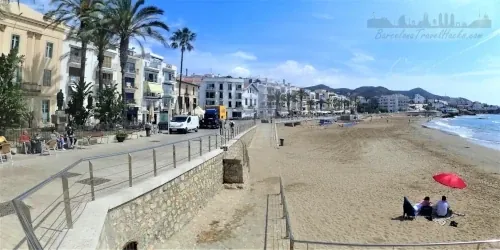
A complete guide to the best beaches in Sitges and the top shopping streets in the town centre. Perfect for a beach day or shopping trip from Barcelona
Read more >
 TRAIN
TRAIN
3.2k views
Maricel Palace Sitges – Architecture, History & Interior Tour
Explore Maricel Palace in Sitges: a whitewashed medieval‑style façade, tiled courtyard, grand salons, cloisters and sea‑view terraces built by Utrillo for Charles Deering
Read more >
 TRAIN
TRAIN
1.9k views