
Please sign in with Google to view the map.
Sign in with GoogleCasa Milà (La Pedrera): Gaudí’s UNESCO Stone Quarry House
Casa Milà (La Pedrera), Gaudí’s stone-quarried modernist house in Barcelona. Discover rooftop chimneys, attic arches, ticket info, history, and nearby Gaudí sites
Views:
3.3k
About Casa Milá / La Pedrera Gaudí UNESCO House
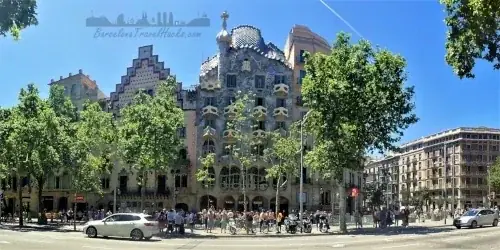
Casa Milà, more commonly known as La Pedrera (meaning “the stone quarry”), is one of Gaudí’s most iconic buildings in Barcelona. The nickname comes from its rugged, undulating façade made of carved limestone, which resembles a natural rock formation. Located on Passeig de Gràcia, just 500 metres from Casa Batlló, it was Gaudí’s final private residential commission and a bold departure from traditional architecture.
Casa Milà / La Pedrera History
The building was commissioned in 1906 by Pere Milà i Camps, a property developer, and his wife Roser Segimon i Artells, a wealthy widow from Guatemala. Construction began with the demolition of the existing house and gardens on the site.
Gaudí employed a revolutionary technique: a free-floating steel frame that supported the façade independently from the interior. This allowed for large window openings and flexible interior layouts. The façade was constructed using a mix of Montjuïc stone powder and mortar to bind blocks of Garraf Massif limestone and Villefranche stone from the French Pyrenees.
Relations between Gaudí and the Milàs became strained due to delays and fines from the city council. A column on the façade extended beyond the official street grid, the rooftop exceeded height limits, and the interior square footage surpassed zoning regulations. Gaudí dismissed these concerns, and Pere Milà was fined heavily — eventually requiring a mortgage to cover costs. The situation was resolved when La Pedrera was declared a monumental building, exempting it from standard bylaws.
Construction was completed in 1910, and by 1912 the Milà family moved into the first-floor apartment. After Pere Milà’s death in 1940, the building was sold to Josep Ballvé i Pellisé, though Roser Segimon remained in residence until her death in 1964.
Over the decades, the building’s original interiors were lost as it was converted into offices, a bingo hall, and subdivided flats. By the 1970s, La Pedrera had fallen into disrepair.
In 1984, Casa Milà was included in the UNESCO World Heritage Site listing for Gaudí’s works. It was purchased by Caixa Catalunya in 1986, which undertook extensive renovations. The fourth floor apartment was restored as a museum, and the attic space and roof terrace were opened to the public as exhibition areas.
Today, Casa Milà / La Pedrera stands as a testament to Gaudí’s architectural genius and remains one of the most visited modernist landmarks in Barcelona.
Gaudí’s Structural Innovations
Unlike Casa Batlló, which was a renovation of an existing building, Casa Milà / La Pedrera was designed and constructed by Gaudí from the ground up. He began by demolishing the original house and garden that occupied the site, giving him complete creative freedom — a rare opportunity that he fully embraced.
At the heart of La Pedrera’s design is a free-form steel frame, a revolutionary concept for its time. This structural skeleton supports the building independently of the façade and internal walls, which act as non-load-bearing infill. The result is flexible floor plans and expansive window openings — a radical departure from the rigid masonry structures typical of the era. A similar innovation can be seen in the Palau de la Música Catalana, where a steel frame allows for a wide, pillar-free auditorium.
Gaudí’s ingenuity extended to the floors themselves. Above the plastered false ceilings, he installed steel stringers spaced approximately 50 centimeters apart, which were filled with shallow Catalan brick arches. This technique produced lightweight yet strong floor slabs that improved both acoustic insulation and thermal regulation.
Natural ventilation was another key innovation. The building’s two large interior atriums act as vertical air shafts, drawing warm air upward and pulling in cooler air through open windows on each floor. This passive cooling system maintained a comfortable indoor climate without the need for mechanical ventilation — a concept well ahead of its time.
The attic space, originally used by servants for drying laundry, also contributed to the ventilation system. Cleverly designed ventilation ports allowed air to circulate through the upper levels. These openings are still visible today — look up at the façade from across the street and you’ll spot them integrated seamlessly into the building’s sculptural form.
Through these structural and environmental innovations, Gaudí not only redefined the possibilities of residential architecture but also laid the groundwork for sustainable design principles that remain relevant today.
Image Gallery For Casa Milá / La Pedrera Gaudí House
Click on any of the 33 images to open full screen gallery player. Note that viewing images is subject to our Fair Use Policy.
Visiting Casa Milá / La Pedrera Gaudí House
It’s worth arriving 20 minutes before your scheduled visit to admire the building from across the street. The undulating stone façade — which earned it the nickname La Pedrera (“the quarry”) — is best appreciated from a distance before moving closer to study the intricate details. At street level, take time to observe the ornate wrought iron balcony railings, designed by Gaudí’s collaborator Josep Maria Jujol, which twist and curl like vines across the limestone surface.
A visit to the interior of Casa Milà / La Pedrera includes several architecturally rich spaces that showcase Gaudí’s creativity and engineering genius:
- The Flower Courtyard: Features a nature-inspired staircase with colorful organic forms and floral motifs.
- The Butterfly Courtyard: Originally designed for horse-drawn carriages to drop off residents, this space evokes movement and elegance.
The entire fourth floor has been restored as a lavish early 20th-century apartment museum. It includes a kitchen, lounge, study, bedrooms, children’s playroom, and hallways surrounding the Flower Atrium — offering a glimpse into upper-class life during Gaudí’s time.
The attic space, built with 270 catenary brick arches, houses the Espai Gaudí museum, which explores Gaudí’s architectural legacy and includes original furniture and models. One of the most fascinating exhibits is a suspended chain model with hanging weights and a mirror placed underneath. This physical model demonstrates how Gaudí calculated the natural curves and load distribution for the Sagrada Família. By inverting the reflection, he could visualize how gravity would shape the arches — a technique that prefigured modern parametric design.
On the multi-level rooftop terrace, you’ll find the famous warrior chimneys — sculptural forms that resemble helmeted sentinels — along with panoramic views over the Eixample district of Barcelona. The rooftop is a surreal landscape of curves, shadows, and symbolism, making it one of the most photographed spots in the city.
Visit duration: Allow 1 to 2 hours to fully explore the museum and rooftop terrace. Arrive early to enjoy the exterior and avoid crowds.
Tip: Bring your own headphones for the audio guide to enhance your visit and avoid using shared devices.
Casa Milà / La Pedrera is a dream location for photographers, offering sculptural forms, dramatic shadows, and panoramic city views. Whether you're shooting with a DSLR or a smartphone, here are the top photo opportunities and tips to make the most of your visit:
- Façade from across the street: Arrive 20 minutes early to capture the full undulating stone façade and ornate wrought iron balconies. Morning light casts soft shadows that highlight the building’s texture.
- Interior courtyards: Use a wide-angle lens to capture the vertical flow of the atriums. The Flower Courtyard’s colorful staircase and the Butterfly Courtyard’s carriage entrance offer rich architectural detail.
- Fourth-floor apartment: Shoot through doorways and mirrors to create layered compositions. The period furnishings and natural light give a warm, nostalgic tone.
- Attic arches: The catenary brick arches resemble whale ribs — perfect for abstract shots. Use low angles and symmetry to emphasize the rhythm of the space.
- Rooftop terrace: The warrior chimneys are iconic. Capture them with the city skyline in the background, especially during golden hour.
Best time for rooftop photography: Book the Sunrise Experience tour for exclusive early access starting at 08:00h. The soft morning light enhances the curves and shadows of the rooftop sculptures, and you’ll avoid the crowds that make photography difficult later in the day.
Casa Milà / La Pedrera Opening Hours
- Open daily:
- Day visits: 09:00 to 18:30
- Last entry: 17:30
- Night tour season: 19:00 to 22:00
Other Gaudí Works to Visit
Gaudí’s former residence is located inside Parc Güell, and can be visited with a combined Parc Güell + Gaudí House Museum ticket.
Just 500 metres down Passeig de Gràcia is Casa Batlló, another Gaudí masterpiece with a dragon-inspired rooftop and bone-like window frames.
For Gaudí’s most ambitious work, visit La Sagrada Família, the iconic basilica still under construction.
Near the bottom of Las Ramblas, explore Palau Güell, a castle-style residence with ornate ironwork and rooftop sculptures.
In the Gràcia neighborhood, visit Casa Vicens, Gaudí’s first major commission. And in Sant Gervasi, don’t miss Torre Bellesguard, where medieval and modernist styles merge.
Each of these Gaudí creations is visually distinct, yet all share his signature blend of nature, symbolism, and imagination. For a full itinerary, explore the Catalan Modernism Architecture Guide.
Accessibility & What to Bring to Casa Milá / la Pedrera
Casa Milà / La Pedrera is largely accessible to visitors with reduced mobility. Elevators and ramps connect the main areas, including the courtyards, Pedrera Apartment, and attic museum space. The roof terrace is accessible via lift to a designated viewing platform. However, due to the stepped and uneven layout of the rooftop, wheelchair users cannot explore the full terrace. A wheelchair loan service is available and must be booked in advance by emailing accessibilitat@fcatalunyalapedrera.com.
Bag policy: Large rucksacks, oversized bags, and bulky items are not permitted. To avoid entry issues, bring only small daypacks or handbags.
Bicycle access: Bicycle anchorage points are available outside Casa Milà / La Pedrera on Carrer de Provença, near the intersection with Passeig de Gràcia.
Audio guide tip: Bring your own headphones to enjoy the audio guide comfortably and avoid using shared devices.
Tickets for Casa Milá / La Pedrera Gaudí House
Just like Casa Batlló, Casa Milà / La Pedrera is one of Barcelona’s most popular Gaudí attractions and often sells out — especially during summer and holiday seasons. Advance online booking is strongly recommended to secure your preferred time slot and avoid long queues. Aim to book at least a few days ahead, and arrive 10–15 minutes before your scheduled entry time for a smooth start to your visit.
Powered by
GetYourGuide
Powered by
GetYourGuide
Powered by
GetYourGuide
Powered by
GetYourGuide
Powered by
GetYourGuide
Getting to Casa Milá / La Pedrera
Address: Passeig de Gràcia 92, Barcelona, 08037
Casa Milà / La Pedrera is located in the heart of the Eixample district, along the elegant boulevard of Passeig de Gràcia. It’s easily accessible by public transport and ideal to include in a walking itinerary of Gaudí’s works.
The nearest TMB Metro stations are:
- Passeig de Gràcia: Served by L3 (green), L2 (purple), and L4 (yellow)
- Diagonal: Served by L3 (green) and L5 (blue)
Passeig de Gràcia connect with Renfe Rodalies and regional train lines. Diagonal connects with FGC vallés lines, making it convenient for visitors arriving from outside the city.
For public transport, use a T-Casual ticket for 10 single journeys, or opt for the Hola Barcelona Travel Card for unlimited travel across metro, bus, tram, and train networks — ideal for multi-day sightseeing.
Casa Milá can also be found on the Hop-On-Hop-Off Barcelona tourist bus Blue Route.