


Gaidí's Torre Bellesguard Gaudí Castle – Tours & History
Explore Gaudí’s hidden castle house in Barcelona. Book guided tours in English. Visit the mosaic staircase, rooftop terrace, and medieval garden
Views:
2.9k
About Gaudì's Torre Bellesguard Castle House
Torre Bellesguard, also known as Casa Figueres, is currently owned by the Guilera family, who still reside in part of the Antoni Gaudí-designed house. This private Gaudí residence in Barcelona was remodeled by Gaudí between 1901 and 1909 in a Gothic art-nouveau style to reflect the existing medieval castle ruins on the site.
The site is also famous in Catalan folklore as the hideout of Joan Sala i Ferrer, known as Serrallonga, a legendary bandit who was hunted by King Felipe IV of Spain’s soldiers and finally captured, tortured, and executed in Barcelona in 1634. The name Bellesguard means “beautiful view” in Catalan, fitting for this Gaudí castle house in Barcelona nestled in the hills of Sant Gervasi.
Gaudí’s design incorporates symbolic elements like the Sant Jordi dragon and irregular stonework, making it a prototype for his later works. This hidden Gaudí architecture blends neo-Gothic and modernist styles, preserving the medieval spirit while showcasing Gaudí’s evolving artistic vision.
Torre Bellesguard could be considered a prototype for Gaudí’s irregular use of stone and symbolic design elements, such as the Sant Jordi dragon. These features reflect his early experimentation with blending Gothic and modernist architecture. This style of construction can also be seen in La Sagrada Família and Parc Güell, making Bellesguard a key part of Gaudí’s architectural evolution in Barcelona.
Torre Bellesguard History
The site consists of the walls of an old castle that was the residence of Martín I the Humane, King of Aragón, Valencia, Sardinia, and Corsica, and Count of Barcelona from 1396, as well as King of Sicily from 1409. At the time of his death in 1410, all of Martín's legitimate descendants, born of his marriage with Queen María de Sicilia, were already dead.
His second marriage did not produce any children. Only an illegitimate grandson, Frederick, Count of Luna—a natural son of Martin the Younger—and an illegitimate daughter remained. All were ineligible for succession due to the rules established during the times of James I the Conqueror. The king, despite his desire and some effort, was unable to obtain sufficient confirmation of Frederick as his successor prior to his death.
Within the medieval walls sits a house constructed by Antoni Gaudí between 1900 and 1909. Gaudí drew inspiration for Casa Figueres from the medieval castle that once stood on the same site, built for the King of Aragón in the early 15th century. When the King died without an heir in 1410, his widow, Margaret of Prades, inherited the estate. Following her death, the castle fell into decline and was passed from hand to hand over centuries until Jaume Figueras i Burull purchased the estate.
Jaume Figueres died in 1877, leaving his widow, Maria Sagués i Molins, in charge of commissioning Gaudí for the project. All that remained of the initial structure were a few walls and the patio. Still, Gaudí was aware of the important history of this location, so he worked to preserve the medieval spirit of the ruins, repairing the outer castle walls. Gaudí sought to blend the construction with its natural surroundings—hence the exterior is made with stone slate.
Gaudí’s decorative elements resonate with the natural surroundings, together with the usual Gothic characteristics. The façade of the structure is still best understood as neo-Gothic, though there is no denying the modernist elements. Gaudí designed the home during a period when he was still developing his unique style. For instance, while the building displays Gaudí’s iconic mosaic detailing and incorporation of natural elements, it does not include Moorish accents and bright colours (aside from the stripes on the tower cross), which are key distinctive characteristics in much of his later works.
Gaudí was given free rein to design and construct what was intended as a second home for the Figueres family. However, this freedom bestowed to the artist later proved disastrous for the family. Figueres died before the construction had finished, leaving the responsibility of overseeing the final stages to his wife, who grew increasingly frustrated with constant delays due to Gaudí’s obsessive detailing.
While the months Gaudí dedicated to placing trencadís (his iconic mosaic technique) on the structure are part of what makes the home so beautiful today, the process added such significant time and cost to the construction that Maria Sagués i Molins was never actually able to live in the home and ultimately had to sell it to avoid bankruptcy.
The house changed hands for several years until the Guilera family purchased the home in 1944 and has continued to own it. When Lluís Guilera Molas first bought Casa Figueres, the doctor intended to convert the building into a modernist hospital, similar to Hospital de Sant Pau, dedicated to cancer treatment and research. The building continued to serve medical purposes following Lluís' death in 1969, when his son, Lluís Guilera Soler, a gynecologist and obstetrician, inherited the home and hospital.
Several Barcelona citizens were born in Casa Figueres until 1974, when the hospital relocated to a more accessible area better suited to medical needs. From that point on, the building has served the purpose that Gaudí always intended: a private residence blending modernist architecture with medieval heritage.
For the past 30 years, the Guilera family has left the gates open, permitting guests to stroll the gardens and observe the home's exquisite exterior. Over the years, they received countless requests from visitors to explore inside the home and enjoy Gaudí’s more modernist interior detailing.
Due to popular demand and the family's realization that restoration was necessary, the Guilera family began plans to open their home to the public in 2009. They officially began inviting tours in September 2013, offering access to the interior accompanied by explanations of the history, architecture, and Gaudí’s design philosophy.
Image Gallery For Gaudì's Torre Bellesguard Castle House
Click on any of the 51 images to open full screen gallery player. Note that viewing images is subject to our Fair Use Policy.
Visiting Gaudì's Torre Bellesguard Castle House
Torre Bellesguard is still a private home. Access to the property is only permitted through a paid guided tour or audio-guided ticket. Entry includes the beautifully restored mosaic staircase, the former smoking room on the first floor, the attic with brick arches, the roof terrace, the stables, and the garden. The limited interior tour offers a rare glimpse into Gaudí’s private residential architecture.
Access to the castle-style garden and architectural features is not available without a ticket. Revenue from ticket sales directly supports the preservation of this hidden Gaudí gem in Barcelona, making your visit both culturally enriching and historically meaningful.
Guided tours are available in English, Spanish, and Catalan. English-language tours are offered at set times, while audio guides in English are available throughout the day. Be sure to bring headphones for the audio guide experience.
This is one of the few Gaudí buildings with guided tours that still functions as a residence. The experience is ideal for those seeking lesser-known Gaudí attractions and a quieter alternative to La Sagrada Família or Park Güell.
Torre Bellesguard Visiting Hours for English Language Tours
Note: Tour times may vary seasonally and are subject to preservation needs and visitor demand.
- Tuesday to Sunday: 11:00 am and 1:00 pm (English guided tours available at these times)
- Closed: Mondays; January 1st & 6th; December 25th & 26th
It is recommended to book in advance as places are limited. Tours in Spanish and Catalan are available at other hours of the day. Audio guides in English, Spanish, and Catalan are available throughout opening hours.
Other Gaudí Works
The house that Antoni Gaudí lived in is located inside Parc Güell, but it is not included in the Sagrada Família ticket. For a more complete experience, I recommend purchasing a combined Parc Güell + Gaudí House Museum ticket. You’ll find full details on the Parc Güell page.
For a modernist architecture walking tour, combine a visit to Casa Batlló with La Pedrera / Casa Milà. These two Gaudí masterpieces are just 500 metres apart along Passeig de Gràcia, making them ideal for a self-guided tour.
For the most iconic of Gaudí’s works, visit the Sagrada Família, a UNESCO World Heritage Site and the crown jewel of Gaudí’s architectural legacy in Barcelona.
You’ll also find Palau Güell, a castle-style house designed by Gaudí, near the bottom of Las Ramblas. For those exploring the Gràcia neighbourhood, don’t miss Casa Vicens, one of Gaudí’s earliest residential projects.
Each of these Gaudí wonders is visually distinct and represents a different phase of his creative evolution. Whether you're interested in modernist interiors, mosaic facades, or gothic-inspired towers, Barcelona offers a rich tapestry of Gaudí’s genius.
Accessibility & What to Bring to Torre Bellesguard
Torre Bellesguard is a private residence with limited public access. While the building is equipped with a lift, it is not available for use during guided tours. Visitors with reduced mobility can access the exterior garden areas and adapted restrooms, but the interior tour requires climbing stairs to reach the first floor, attic, and rooftop terrace.
The garden is on one level but includes a gentle incline and gravel paths, which may be challenging for wheelchairs or walking aids. It’s recommended to contact the venue in advance if you require mobility assistance.
There are no bicycle anchorage points nearby, and no lockers are available on-site. Avoid bringing large bags; a small 10L rucksack is usually permitted, though you may be asked to wear it on your chest inside the house.
For audio-guided tours, don’t forget to bring headphones and a charged mobile device. The audio guide is available in English, Spanish, and Catalan.
Tickets for Gaudì's Torre Bellesguard Castle House
Powered by
GetYourGuide
Getting to Gaudì's Torre Bellesguard Castle House
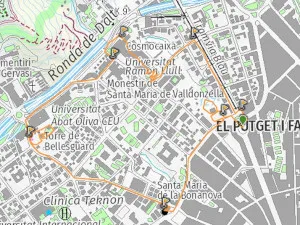
Address: Carrer de Bellesguard 20, Barcelona, 08022 — located in the Sant Gervasi district, just steps from Plaza Bonanova.
This Gaudí castle house near Tibidabo is easily accessible by public transport. The nearest FGC station is Avinguda Tibidabo on the brown (L7) line. From there, it’s a short uphill walk through one of Barcelona’s most elegant residential neighborhoods.
Use a T-Casual or Hola Barcelona travel card for unlimited rides — ideal for visitors exploring hidden Gaudí architecture or planning a self-guided modernist tour.
There is no dedicated parking at the site, and bicycle anchorage points are not available nearby. Walking or public transport is recommended for the most convenient access.
Documents for Gaudì's Torre Bellesguard Castle House
Wikiloc Trail for Gaudì's Torre Bellesguard Castle House
Please sign in with Google to view the Wikiloc Route map.
Sign in with GoogleWeather for Gaudì's Torre Bellesguard Castle House
Where to stay near Gaudì's Torre Bellesguard Castle House
Nearby Attractions to Gaudì's Torre Bellesguard Castle House
 FGC+BUS
9.6k views
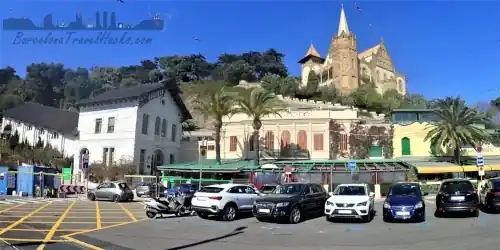
TC2 Bus & Tibidabo Funicular (Cuca de Llum) from Plaza J.F. Kennedy
Ride the Cuca de Llum Funicular to Tibidabo Amusement Park. Spain’s first funicular, now modernized. History, ticket options, and how to get there
Read more >
 FGC
FGC
6.7k views
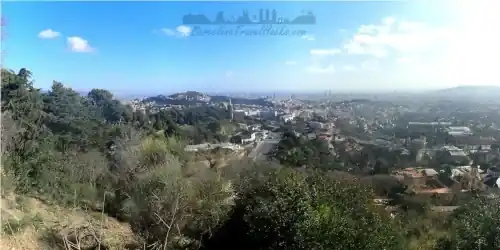
Barcelona to Tibidabo via Forest Path & Fabra Observatory
Easy 3.44 km forest trail from FGC Av. Tibidabo to Tibidabo Church, viewpoint, and amusement park via Fabra Observatory
Read more >
 FGC
FGC
4.9k views
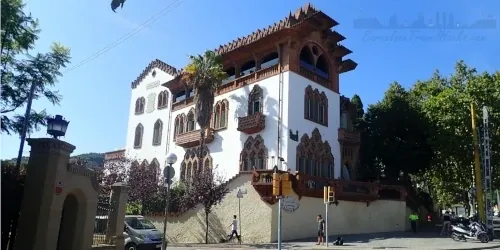
Avenida Tibidabo – Historic Boulevard & Modernist Villas
Walk this grand avenue from Plaza John F Kennedy to Tibidabo. Admire modernist villas, historic mansions, and dine in a restored architectural gem
Read more >
 FGC
FGC
3.8k views
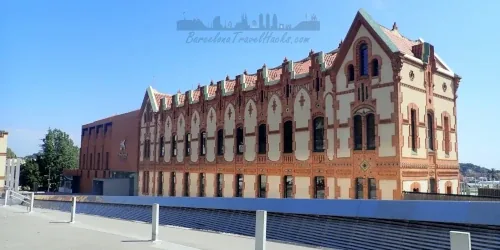
CosmoCaixa Science Museum – Rainforest & Planetarium
Explore Barcelona’s top science museum. Hands-on physics, indoor rainforest, planetarium shows & more. Free entry for La Caixa customers
Read more >
 FGC
FGC
3k views
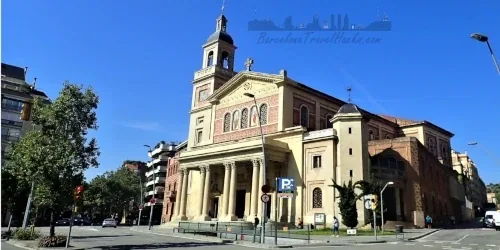
Roman-Style Church in Sant Gervasi Barcelona
Discover Mare de Déu de la Bonanova, a hidden Roman-style church in Sant Gervasi with Catalan mass, organ music, and rich architectural history
Read more >
 FGC
FGC
2.8k views