
Parc Güell Barcelona: Gaudí’s Mosaic Park, Tickets & Tips
Visit Parc Güell, Gaudí’s iconic mosaic park in Barcelona. Explore sculptures, viewpoints, ticket info, opening hours, and tips for your visit to this UNESCO site
Views:
4.1k
About Parc Güell
Parc Güell is one of Barcelona’s most iconic landmarks — a colorful mosaic-filled park designed by Antoni Gaudí and located in the Gràcia/La Salut neighborhood. Originally conceived as a luxury housing estate, it was transformed into a public park in 1926 and has since become a UNESCO World Heritage Site.
Origins and Vision
Commissioned by industrialist Eusebi Güell in 1900, the park was inspired by the English Garden City movement. The plan included 60 triangular plots for high-end homes, but the project failed commercially. Only two houses were built — neither by Gaudí — and one of them became Gaudí’s personal residence from 1906 until his death in 1926. This house is now the Gaudí House Museum.
Architectural Significance
Parc Güell showcases Gaudí’s signature style: organic forms, vibrant mosaics, and nature-inspired structures. Highlights include:
- The Dragon Stairway with its famous tiled salamander sculpture
- The Hypostyle Room with 86 Doric columns supporting the main terrace
- The Serpentine Bench, a winding mosaic seat offering panoramic views
- Two whimsical Gatehouses resembling gingerbread cottages
Cultural Legacy
Declared a public park in 1926, Parc Güell was recognized as a Historic Artistic Monument in 1969 and added to the UNESCO World Heritage list in 1984. It remains a symbol of Catalan modernism and Gaudí’s visionary approach to architecture and urban planning.
Today, Parc Güell is divided into a free-access upper zone and a regulated Monumental Zone requiring timed-entry tickets. It’s a must-see destination for lovers of art, architecture, and nature.
Parc Güell Background and History
Parc Güell was originally conceived as a luxury residential development — a visionary project commissioned by Count Eusebi Güell i Bacigalupi and designed by Antoni Gaudí. Inspired by the English Garden City movement, the plan was to create a self-contained estate of 60 upscale homes nestled into a landscaped park, offering fresh air and panoramic views far from the industrial smog of downtown industrial Barcelona.
The site chosen in 1900 was a rocky, sparsely vegetated hill known as Muntanya Pelada ("Bare Mountain"), located behind the affluent La Salut neighborhood. It included an existing country house — Larrard House — which Count Güell later occupied in 1906 to lend prestige to the development.
Despite its ambitious design and Gaudí’s involvement, the project was a commercial failure. Only two houses were built, neither designed by Gaudí. One was intended as a show home, but failed to attract buyers. In 1906, Gaudí purchased it with his own savings and lived there with his family until his death in 1926. This house is now the Gaudí House Museum, built by architect Francesc Berenguer i Mestres and opened to the public in 1963.
The second house, Casa Martí Trias i Domènech, was built in 1905 by architect Juli Batllevell i Arús for lawyer Martí Trias and his wife Ana Maxenchs. Their son Alfonso, a close friend of Gaudí, would later identify Gaudí’s body after his fatal tram accident in 1926. Casa Trias remains a private residence and is not open to the public.
With the housing project abandoned, the site was transformed into a municipal park in 1926 — the same year Gaudí died. It was declared a Historic Artistic Monument in 1969 and awarded UNESCO World Heritage status in 1984.
Today, Parc Güell stands as a testament to Gaudí’s genius and the utopian ideals of early 20th-century urban planning — a place where architecture, nature, and imagination converge.
Image Gallery For Parc Güell
Click on any of the 91 images to open full screen gallery player. Note that viewing images is subject to our Fair Use Policy.
Visiting Parc Güell
As of 2025, Parc Güell is a fully regulated site. All visitors must purchase a ticket to enter, including access to the upper wooded areas that were previously free. The park is divided into zones, but ticketed entry now applies to the entire site, with the exception of local residents who hold a valid access card.
Resident Access
Residents of neighborhoods adjacent to Parc Güell — specifically El Coll, Vallcarca-Penitents, La Salut, El Carmel, Can Baró, and Baix Guinardó — are eligible for free entry during designated hours (07:00–09:00 and 18:00–22:00).
If you are empadronado (officially registered) in one of these neighborhoods, you can request a resident access card by calling 010 or through the procedures section of the Barcelona City Council website.
What to See Inside Parc Güell
- The Dragon Stairway with Gaudí’s famous tiled salamander sculpture
- The Hypostyle Room with 86 Doric columns and acoustic features
- The Serpentine Mosaic Bench offering panoramic views of Barcelona
- Two Gatehouses resembling gingerbread cottages
- The Nature Square — a large open terrace with mosaic seating
Tips for Your Visit
- Best time to visit: Early morning between 09:00–11:00 for fewer crowds and softer light
- Duration: Allow at least 2 hours to explore the park fully
- Footwear: Wear comfortable shoes — expect stairs, uneven paths, and lots of walking
- Weather: Bring water and sun protection in summer; shaded areas are limited
Parc Güell is not just a park — it’s a living museum of Gaudí’s imagination, blending architecture, nature, and symbolism. Plan ahead to make the most of your visit.
Is Parc Güell Worth Visiting?
Some recent travel articles and online reviews have questioned whether Parc Güell is overrated. These opinions often come from visitors who only saw the Monumental Zone briefly or didn’t understand the park’s historical and architectural significance.
Parc Güell is far more than a photo stop. It was originally envisioned as a luxury housing estate for Barcelona’s elite, designed by Antoni Gaudí and commissioned by Eusebi Güell. Although the residential project failed, the result is a unique urban park that blends modernist architecture, natural forms, and symbolic design.
On this page, you’ll find an extensive photo gallery and detailed explanations of what you can see when exploring the entire site — from the Dragon Stairway and Hypostyle Room to the Gaudí House Museum and panoramic viewpoints. The layout reflects the original street plan, complete with gatehouses and two surviving homes. I invite you to take a look and judge for yourself.
Parc Güell is Gaudí al fresco — an open-air museum where you can walk among his mosaics, sculptures, and architectural experiments surrounded by nature and sweeping views of the city.
Whether you're passionate about Gaudí’s architecture, interested in UNESCO World Heritage sites, or simply looking for a scenic walk with stunning views over Barcelona, Parc Güell is absolutely worth visiting.
Other Gaudí Works in Barcelona
If you're exploring Gaudí’s architectural legacy beyond Parc Güell, Barcelona offers several must-see masterpieces — each one visually distinct and rich in symbolism.
The most iconic is the Sagrada Família, Gaudí’s unfinished basilica and a UNESCO World Heritage site. It’s the grandest of his works and a symbol of Catalan modernism.
For a compact walking route, combine Casa Batlló with Casa Milà (La Pedrera) — both located on Passeig de Gràcia and just 500 metres apart. These buildings showcase Gaudí’s evolution in form, texture, and light.
In the Gràcia neighborhood, you’ll find Casa Vicens, Gaudí’s first major commission — a vibrant blend of Moorish and oriental styles.
Further northwest in Sant Gervasi, visit Torre Bellesguard, a lesser-known gem that fuses medieval and modernist elements with panoramic views.
Together, these sites form a Gaudí trail through Barcelona — a journey through organic architecture, mosaic artistry, and visionary design.
Accessibility & What to Bring to Parc Güell
Parc Güell is built on a hillside with multiple terraces connected by stairs and sloped paths. While some areas are challenging, the park does offer accessible entrances via Carrer d’Olot and Carretera del Carmel, which lead directly to the main terrace level.
Visitors with wheelchairs or pushchairs should plan ahead, as not all areas are step-free. The Monumental Zone includes ramps, but some viewpoints and paths may be uneven or steep.
Bicycles are not permitted inside Parc Güell to preserve the monuments and ensure pedestrian safety. However, bicycle anchorage points are available outside the park at Carrer d’Olot and Carrer de Marianao.
What to Bring
Large bags and suitcases are not allowed inside the park Especially important in summer — shaded areas are limited Hat, sunglasses, and sunscreen recommended Expect stairs, uneven paths, and lots of walking Capture Gaudí’s mosaics, sculptures, and panoramic views
Tickets for Parc Güell
Important: Parc Güell limits entry to 1,400 visitors per hour to preserve the site and ensure a quality experience. To avoid queues or being denied entry, it’s strongly recommended to book tickets online in advance.
Ticket Options
- Standard Ticket: Includes access to all public areas and the Monumental Zone
- Combined Ticket: Includes Parc Güell + Gaudí House Museum
- Guided Tour: Available in multiple languages with expert commentary
Tickets are timed and must be used within 30 minutes of the scheduled entry. Late arrivals may be refused entry.
Getting to Parc Güell
Address: Avenida del Santuari de Sant Josep de la Muntanya, 08024 Barcelona
By Metro
- Lesseps (L3 – Green Line): 15-minute uphill walk via Carrer de Larrard
- Vallcarca (L3 – Green Line): Offers escalator access via Baixada de la Glòria
By Bus
- Bus H6 or D40: Stops near Travessera de Dalt
- Bus 24 or 92: Stops at Carretera del Carmel, close to the main entrance
Tourist Bus Advisory
The Barcelona Bus Turístic Blue Route stops at Ronda del Mig, which is a steep uphill walk from Parc Güell. This route is not recommended for visitors with reduced mobility. Consider using local buses or metro stations with escalator access instead.
Travel Tip: Use a T-Casual card for single journeys or a Hola Barcelona Travel Card for unlimited public transport during your stay.
Documents for Parc Güell
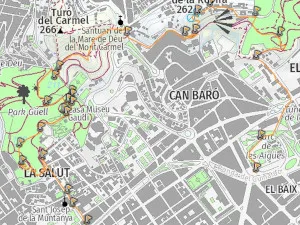
Wikiloc Trail for Parc Güell
Please sign in with Google to view the Wikiloc Route map.
Sign in with Google